Showing posts with label fashion and film. Show all posts

Wednesday, 2 October 2013

Film Club - 10 Reasons To Watch - To Catch A Thief


To Catch A Thief - 1955 - Alfred Hitchcock

This film is a favourite of many and there are many, many, far more than 10 reasons to watch this film. Again.

1. Grace Kelly - not just for the beautiful ice blond but for the behind the scenes story too. This is the film that made her a Princess, she met Price Rainier on location.

2. Edith Heads design - each and every dress is breathtakingly Hollywood. Draped chiffon's, embroideries, start contrasts, They are all fabulous.

Edith said this of the film in her Biography 'Edith Head's Hollywood' .....
"When many people ask me who my favourite actress is, who my favourite actor is, who my favourite director is, and what my favourite film is, I tell them to watch To Catch A Thief and they'll get all the answers"

3. Cary Grants dressing - Cary Grant dressed himself as he did in many films and purchased his elegantly styled French wardrobe in Canne. His first outfit, the fine striped navy sweater, the red polka dot cravat all wonderfully fitted is the height of mens true style.


3. Vista Vision - created by Paramount in 1954 and used to full effect by Hitchcock with wide landscape shots of the Cote d'Azure. Beautiful picture postcard shots is great high res quality and colour were the result and sadly only used in a small number of films until 1961.

4. Technicolour - The blues, reds and the flowers market scene are spectacular. The colours aren't completely saturated and softer, more elegant than my favourite starkly contrasted films. Soft pinks, dusty blues and pastel yellows, all the colours of a 1950s rose garden along with a Parisian black and green for the night.

5. The first look at Grace Kelly on the beach - dressed in a yellow swimsuit and matching hat. She sits in the background long limbed and screen stealingly devine.


6. That black and white outfit - Edith Head said of this outfit "When Grace went to the beach, she wore a huge sun hat and the most beautiful black and white sun costume that I've ever done. It was striking - almost too striking."

7. The white dress - this is the dress that recently inspired the dress I designed for Nicole, The Niagara dress. It's a finely draped chiffon dress that wraps tightly around the body, is shaped in fine chevrons at the waist and then floats like a dream. One of the perfect white dresses in history.

8. Brigitte Auber - Yes, Grace is the there stealing the screen with her perfect beauty like an angel but the second female in this story is Danielle. So French, so chic and just gorgeous. She didn't get the beautiful dresses but did dress wonderfully defining European youth style.
Cleverly dressed in the red version of Cary Grants stripe sweater at the start with a rose red skirt giving the audience the biggest clue of the story.

9. The Gold Dress - made in a gold mesh and so huge and so expensive they had to be ever so careful to keep the dress perfect during filming. Hitchcock told Edith that Grace was to look like a Princess. The Marie Antoinette dress seems to float as she dances like a doll in a music box, it's so over the top but on viewing against the midnight blue sky of the ball its so very magical.


10. Hitchcock - he said about the dressing of the film " we are now in France. People dress here. It's the place style is created - so do it" Edith Heads Hollywood
He is the man who used Vista Vision, the man who directed and produced this beautiful film paying so much attention to detail as always and the man who I like to think made Grace Kelly a Princess. Awhh.


To Catch a Thief: 1955 
Director: Alfred Hitchcock
Cinematographer: Robert Burks
Technicolour Consultant: Richard Mueller
Starring: Grace Kelly, Cary Grant, Jessie Royce Landis, Brigitte Auber
Costume Design: Edith Head 

Time to Watch - On a Monday night to inspire you for the rest of the week.

Wednesday, 24 July 2013

Marie Antoinette - Costume and Film


Film and Costume - Marie Antoinette the influence on fashion

The influence of Sofia Coppola's Marie Antoinette is now a fashion cliche in the realms of Audrey Hepburn and the famous French macaroon. Manolo Blahnik designed the shoes and it's no surprise when things are this beautiful that the latest Dior campaign and countless fashion shoots have all been inspired by this iconic cult movie.
This is all down to the incredible Oscar winning designs of Milena Canonero.

The overall look of  the film is set in soft pastels, blues and silk tones (inspired by those Laduree macaroons) evoking the great Cecil Beaton photograph of Charles James ball gowns.
 The cinematography is bright and light with fresh summer skies and gorgeous grainy dusk's giving that intimate youthful aire. There are many eye level shots immersing the audience as a character in the room with Marie-Antoinette. This is then contrasted with huge wide shots of the steps at Versailles for grand scale of the location.


The soundtrack takes genre out of it's stuffy period-drama box and markets as a teen movie whilst the rest of the audience is filled with a nostalgic haze for the beauty of youth that Coppola captures so well.
It's not dramatic in the British period drama way leaving out the usual pout and hyper ventilation in tight corsets. Instead she opts for a cool casual aire.
Coppola positions Antoinette as a down to earth girl,  like any of her age, who doesn't really grow up in her candy box surroundings. The real Marie-Antoinette  was a teenager thrown into being the Dauphine of France at fifteen.


The sets are breathtaking, rooms to make your heart pound with indulgence, the real vast gardens of Versailles, the redecorated rooms at the Palace (which Coppola was given permission to use) filled with the specialist cake departments works of art and detail galore. Trims are trimmed and trimmed again.  Even inside the carriage looks divine papered in blue silks and gold swirls.
Just what you'd expect but in some way it all looks comfortable and real, not so staged.

This is also the feeling you get with the costumes, it doesn't feel like the actors have all dressed up, they wear their gowns and frock coats comfortably like modern clothing today. They are worn in such a relaxed manner. Canonero said In The London Times Magazine: "We squeezed the essence of the period, without reproducing it. Even if you think you know a lot about it," she argues, "you always have to look for a new angle. I simplified the very heavy look of the 18th century. I wanted it to be believable, but more stylised."


The first outfit Antoinette is wearing is pale blue velvet, we talked about the significance of pale blue earlier in the blog and the feminine romance associated with this specific colour.
The dress in Austria is altogether more modest, neat fitted jackets buttoned to the neck, fine ribbon hair bows, and softer hair. On becoming French the costume becomes more flamboyant in couture a low scooped neckline, an austere up-tight look with Tricorn hats and adornments all over.


This constricted look continues at the palace, the wedding dress with a bare neckline and very delicate jewels but powdered stiff hair giving an awkwardness at the occasion.
The 'ridiculous' morning dressing scene demonstrates control by disallowing her to dress herself, something to rebel against. I love all the frilled ladies in waiting surrounding the naked Antoinette and the soft simple smocks she wears to sleep in.
And then we have the famous couture shopping montage (yes the best fashion montage around) picking silk fabrics, the confectious shoes, feathers and ruffles. To compare this scene with the makeover scene in Clueless wouldn't go amiss and such fun indulgence in the characters personal style.
Check out the blue converse high tops lying next to the little shoes in this scene, this shot sums up the whole tone of the film.


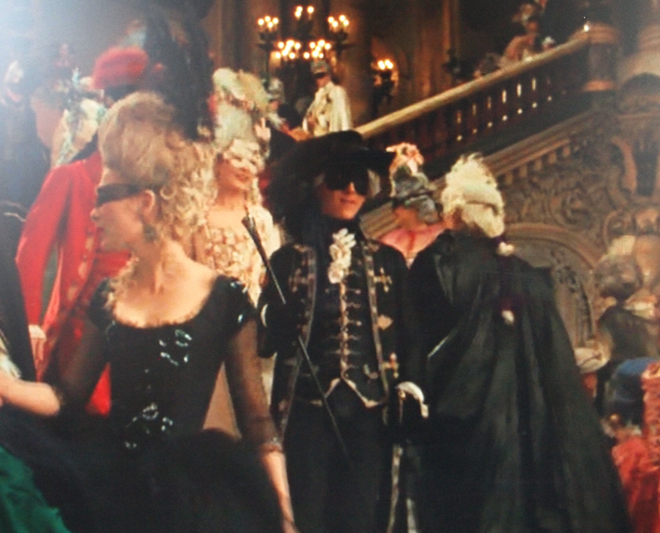
The black ball gown is the first outing of Antoinette's chosen more confident defined style with the tulle eye mask (also used in the latest Dior ad) is rock modern with a t shirt cut to the bodice and sheer panels making her stand out against the colourful guests with 'a cool girl' mystery.


The colours in the palace maintain a soft pastel tone for most characters throughout the film with the occasional shot of colour for key roles in a deeper yellow, royal blue or red. Comtesse Du Barry shows off her sexual prowess in her rich reds, blues and purple silks against her cascading black locks as the scarlet woman. Contrasted with the yet to be deflowered Antoinette the costumes reveal the sexual undercurrent to the story.
And then there is the style change after the long awaited consummation and a child is born. Suddenly independence at Trianon with free fitting bohemian white dresses, soft voile's and lawns, reminiscent of Poiret or back to Austen days and romantic country cottage paintings. It makes me imagine the early days of Laura Ashley with all that Edwardian impressionist romance instilled in the designs.


On return to the palace the dress is austere again but with style details like the red velvet belt on the pale blue dress signifying the lustrous affair and longing love, many peoples favourite outfit of the film. There is a Japanese influence in kimonos, dressing gowns and a maturing style and black worn for mourning, the children softened with pale blue trims on black. The colours gradually then go to black and white then white with a black ribbon. And then the last outfits in smokey solemn blue fading to a dull denim grey.


Many people question this film, many say nothing happens and it is a quiet film but visually I don't think they could have done more to indulge the eyes. There are approximately 65 costume changes for Kirsten Dunst in this film. I lost count but you can see them all and read about them here on the costumers guide site. 
Each and every one expresses a part of the story, an emotion or event and this is just the main character. There are the supporting roles, the men, the children, the sets and the sounds that all make this one of the most influential films for fashion and style.

Marie Antoinette 2006, 
Director: Sofia Coppola
Cinematographer: Lance Acord
Art Directors: Anne Seibel and Pierre Duboisberranger
Costume Design: Milena Canonero
Plus a huge list of very talented people in the hair, make-up, art and costume departments.
All photos are taken from the film and are not to be used commercially.